


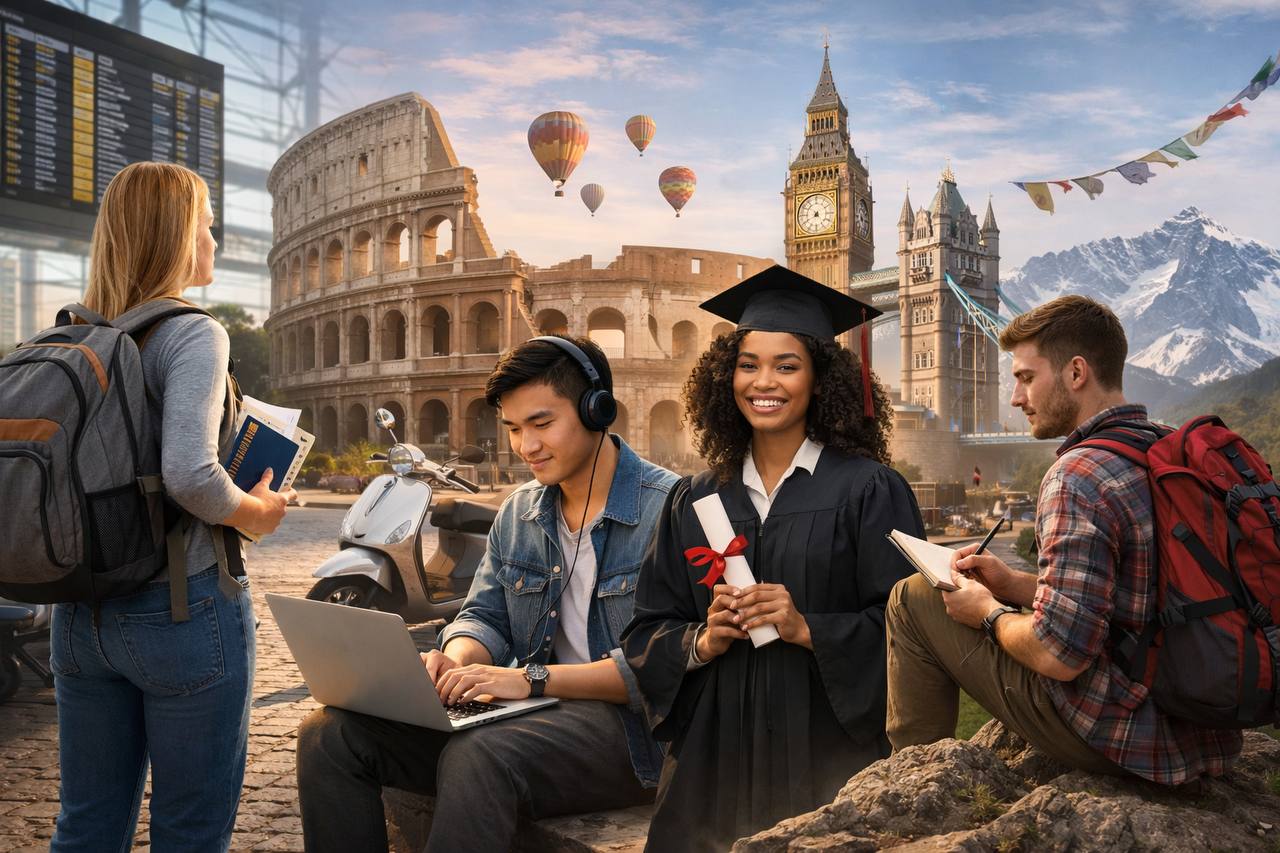
If, after reading the first part of the title, you pictured small indigenous communities in the Arctic or imagined makeshift tent schools in the middle of the tundra, you’re not entirely wrong — such learning setups do exist.
But that’s not what we’re talking about today.
The term itinerant education is also used in a broader sense to describe academic mobility programs where students move between multiple countries as part of a single study trajectory. So, what makes this format so appealing? And is it really all that new? Let’s dive in.
Contents:
- What is itinerant education?
- New, yet old-fashioned
- How it works in practice: program examples
- Why students choose mobility
- FAQ
What is itinerant education?
Itinerant education is a model in which students change their place of study several times during a single educational program. Unlike a traditional academic exchange — which usually lasts a semester or a year — itinerant education forms a continuous learning trajectory, where moving between countries is an integral part of the curriculum. This mobility isn’t just logistics; it’s a pedagogical tool designed to achieve specific goals, helping students grow their skills and broaden their experiences.
The core feature of itinerant programs is personal growth through changing environments.
New, yet old-fashioned
As you may have noticed, the idea of “educational journeys” is far from new. In 17th–18th century Europe, there was a very popular tradition known as the Grand Tour (French: Grand Tour — “the great journey”). After finishing school or university, young aristocrats (usually aged 17–21) would embark on long journeys across the continent, with Paris and Rome considered essential stops.
These trips, lasting months or even years, were about more than sightseeing. Young nobles learned foreign languages, explored different cultures, studied architecture and history, and made valuable connections (sometimes even finding spouses along the way) — in short, they were being educated in the world, not just in classrooms. The experience expanded horizons and was considered an essential part of elite upbringing.
The good news? Today, you don’t need aristocratic roots to embark on your own “Grand Tour”. What was once a privilege of the wealthy has returned in a modern form: universities are partnering to create international mobility programs, making travel a core part of the educational journey.
How It Works in Practice: Program Examples
Minerva University (USA) — one of the most striking examples of modern itinerant education. During their studies, students don’t just change countries — they move across four continents: the first year is spent in San Francisco, the second in Tokyo, and the third and fourth years can be spent in one of several cities: Berlin, Buenos Aires, Hyderabad (India), Seoul, Taipei, or London.
LEINN International (Spain) — a bachelor’s program accredited by Mondragon University. Each academic year takes place in a new city: Bilbao first, then Berlin, followed by Seoul. The fourth year, focused on the thesis, is location-independent: students can return to a previous city or move to a new one. The program emphasizes team projects and launching real startups, giving students a head start on their careers while still studying.
Forward College — a European college with a unique itinerant model: students spend the first year in Lisbon, move to Paris for the second year, and finish in Berlin. The city sequence is carefully planned to match the educational program. Each stage comes with support — from helping students adapt to the new city to professional counseling.
Erasmus Mundus Joint Masters — another format closely aligned with itinerant education. These joint master’s programs involve studying at campuses in two or three different countries. Graduates receive joint or double degrees from multiple universities. The range of cities is vast: Erasmus Mundus includes not only EU countries but also many institutions across Europe, Asia, the Americas, and Africa.
Why Students Choose Mobility
The itinerant education model is gaining popularity among international students — and it’s easy to see why. This format offers unique advantages often unavailable in traditional, “stationary” universities:
1. Global experience
Studying in multiple countries allows students to fully immerse themselves in new cultures and educational systems. It teaches them to adapt to different social and academic contexts while developing:
- intercultural communication
- mental flexibility
- collaboration skills across nationalities
2. Personal and professional skill development
Itinerant education fosters independence, responsibility, and time management. Students also learn to:
- manage projects and work effectively in teams
- think critically and solve problems efficiently — both academic and everyday ones
3. Academic opportunities and diversity
Moving between cities and countries broadens horizons and exposes students to different teaching methods and systems:
- lectures, seminars, and workshops in multiple languages and pedagogical styles
- interdisciplinary projects and hands-on practical work
- participation in international research and startup initiatives
4. International networks
Another key advantage is the opportunity to build a global network. Students make connections that are both professional and social, including:
- classmates and professors from different countries
- contacts for internships and career opportunities
- connections in industry, including local companies and startups
5. Personal growth and self-discovery
Finally, studying in new cities and countries is a powerful way to step out of your comfort zone. It teaches students to make independent decisions, understand themselves and others, and discover their strengths and weaknesses. This experience doesn’t just make you more competitive for jobs or graduate school — it helps you develop a mature outlook on life.
And perhaps that’s the most important part.
"The farther I go, the closer I get to myself," said Andrew McCarthy — and we couldn’t agree more.
Frequently Asked Questions (FAQ)
1. Why study in several countries?
It’s a great way to step out of your comfort zone and truly experience life in a new place—not as a tourist, but as part of the local community. These programs broaden your perspective and teach you how to connect with people from different cultures, skills that are especially valuable in today’s globalized world.
2. Who is itinerant education for, and who might be better off with a traditional university?
Itinerant education is ideal for students who are open to change, enjoy international environments, are ready for independence, and want to gain global experience during their studies. A traditional university may suit those who value stability, prefer staying in one place, and are not keen on frequently changing countries and cultures.
3. What language is the instruction in? Do I need to know several languages?
Most itinerant education programs are taught in English. Knowing additional languages is not required, but it can be a big advantage for everyday life and communication in different countries.
4. How is itinerant education different from exchange programs?
Itinerant education is a single, pre-planned academic pathway where moving between countries is an integral part of the program. Exchange programs, by contrast, are temporary (a semester or a year) and complement studies at a home university rather than defining the entire structure.
5. How many degrees will I receive after graduation?
This depends on the specific program. Graduates may receive one degree, a joint degree, or two or more degrees (double or multiple degrees) from partner universities.
6. How do employers view these programs? Will this give me a career advantage?
Yes. Employers highly value graduates of itinerant programs for their intercultural experience, adaptability, independence, and strong soft skills, as well as their ability to work in international environments and adjust quickly to change.
7. Is it more expensive than regular study abroad?
Itinerant education is not necessarily more expensive — and can sometimes be even more affordable — especially when scholarships or financial support are available (for example, at institutions like Forward College). The exact cost depends on the program and the countries involved.
8. Where should I start if I want to study through an itinerant education model?
Start by defining your goal: which programs interest you and in which countries you’d like to study. Research entry requirements and deadlines, compare programs, costs, and scholarship options. In many cases, it’s helpful to book a personal consultation with an expert who can assess your profile, suggest suitable options, and help you build a clear application strategy.