


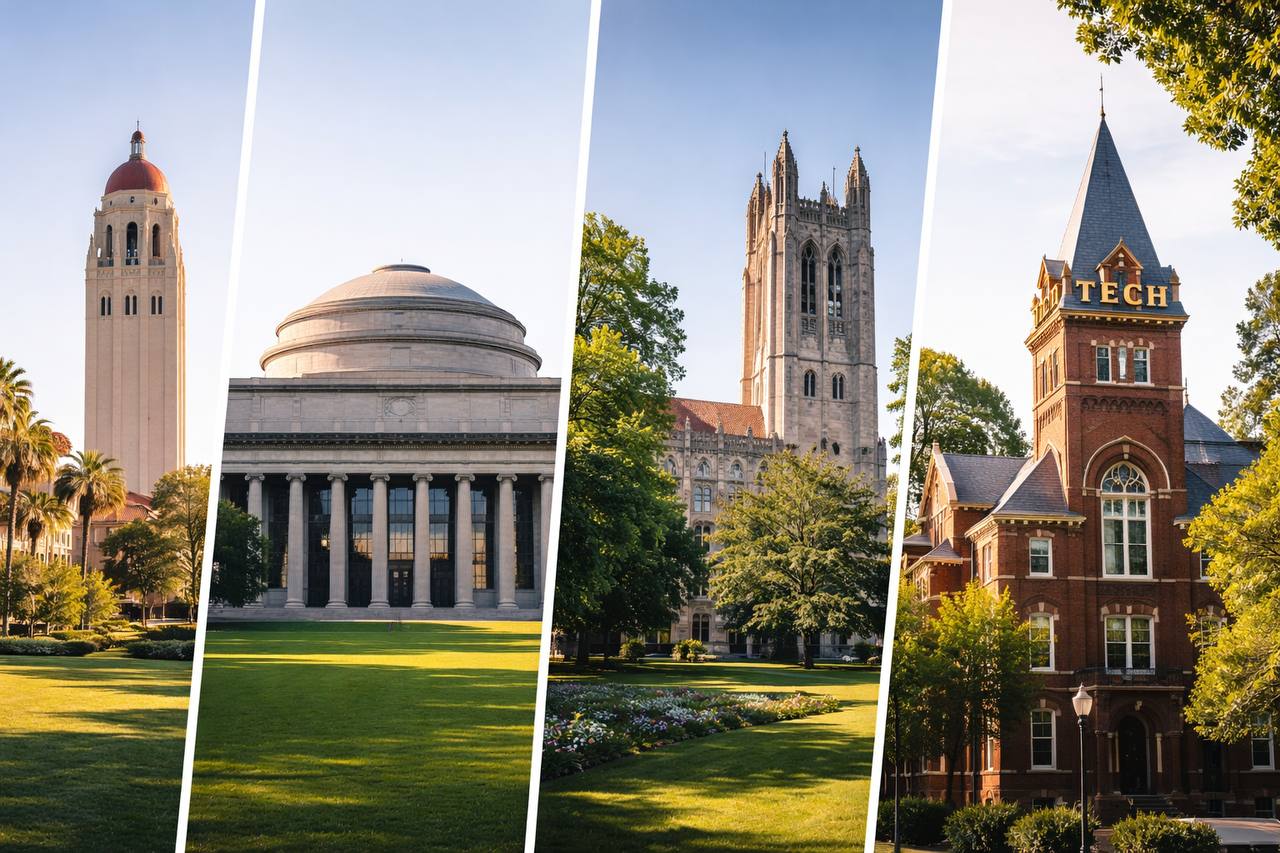
If you ask Google where the world’s richest people studied, AI will generate something like this in half a second:
“The world’s richest people most often studied at elite U.S. universities (the Ivy League), especially the University of Pennsylvania and Harvard, as well as Stanford, MIT, and Oxford. Many billionaires earned degrees in finance, economics, or IT…”
It’s not just AI that thinks this way. Many of us share the same belief — and partly, it’s understandable. The Ivy League is widely seen as something luxury-level and ultra-elite. We’re used to thinking that real success is possible only through a small group of “right” universities like the Ivy League or Oxbridge.
We’ve even shared stories of their famous alumni ourselves, showing how an excellent education played a major role in their lives.
But does prestigious always mean the best? And is it really impossible to succeed without a Harvard diploma? That’s exactly what this article explores.
Contents:
- Is the Ivy League the only path to success? (Spoiler: no)
- Where famous business leaders and political figures studied (beyond the Ivy League)
- Why university rankings aren’t the main criterion in 2026
- What actually matters when choosing a university
- Final thoughts: how strategic thinkers choose their education

Is the Ivy League the Only Path to Success? (Spoiler: No)
Let’s start with the basics: what the “Ivy League” actually is, which universities belong to it, and why so many applicants dream of getting in.
The Ivy League is a group of eight of the oldest and most prestigious private universities in the United States. It includes:
- Harvard University
- Princeton University
- Columbia University
- Yale University
- University of Pennsylvania
- Brown University
- Dartmouth College
- Cornell University
Originally formed in 1954 as an athletic conference, the Ivy League gradually became a symbol of elite education and the highest academic status. And this reputation didn’t come out of nowhere: these universities truly are among the strongest in the world. Many of them date back to the 17th and 18th centuries — the oldest, Harvard, was founded in 1636.
At the same time, the idea that only a diploma from one of these universities guarantees success is greatly exaggerated — with a little help from modern media, of course.
Here’s the English translation, keeping the structure, tone, and rhythm natural and readable — no over-polished “AI voice,” just clear, human language.
How do social media and the media shape our perception?
The Ivy League is, first and foremost, an academic association. But it’s also a powerful brand. And just like with commercial brands, universities are often judged by their prestige and name recognition — not only by what and how they actually teach.
Mainstream media, social networks, and even the film industry actively reinforce this perception. Every year we see rankings of “top universities,” lists of billionaires with Ivy League degrees, and movies about famous students and alumni (think The Social Network or Good Will Hunting), and so on.
Much less attention is given to successful people who earned their degrees at other, less elite universities. As a result, many young people end up focusing more on the aesthetic image than on real academic quality or long-term career prospects.
Why is this dangerous for applicants?
With all due respect to Ivy League universities — their contribution to the global academic community is undeniable, and the value of their diplomas is very real — it’s a serious mistake to see them as the only guaranteed path to success. This mindset creates several risks for applicants aiming for top universities:
- Fear of failure. Many talented, highly motivated students convince themselves that they’re “not good enough” for Ivy League-level universities. As a result, they may not even apply to schools where they actually have a realistic chance.
- Ignoring strong but less prestigious alternatives. There are countless universities around the world that offer excellent education and strong career outcomes. But if you focus exclusively on the “top eight,” you risk missing other options that could be a much better fit.
Where Else Did Famous Business Leaders and Political Figures Study (Beyond the Ivy League)?
As we’ve already mentioned, far from all successful people are graduates of elite universities. Many global leaders and entrepreneurs earned their degrees at other strong institutions (such as École Polytechnique in France) — or even built their careers without a prestigious diploma at all. And that didn’t stop them from achieving outstanding results.
Here are a few striking examples:
Bernard Arnault — Chairman and CEO of LVMH (Louis Vuitton Moët Hennessy), the world’s largest luxury goods conglomerate. His net worth is estimated at around $195 billion. Arnault earned an engineering degree from École Polytechnique, one of France’s leading grandes écoles.
Martin Eberhard — co-founder of Tesla, Inc. He graduated from the University of Illinois Urbana–Champaign, where he studied computer engineering.
Robert Iger — American business executive, former CEO and Chairman of The Walt Disney Company. He holds a bachelor’s degree from Ithaca College, with a focus on television and radio.
Satya Nadella — American business executive of Indian origin and CEO of Microsoft. He completed his undergraduate studies at the Manipal Institute of Technology (India) and later earned a master’s degree in computer science from the University of Wisconsin–Milwaukee (USA).
Jack Ma — Chinese entrepreneur, founder of Alibaba Group, and billionaire. His net worth is estimated at $25.7 billion. He graduated from Hangzhou Normal University with a bachelor’s degree in English.
Carlos Slim — Mexican business magnate and investor, billionaire. From 2010 to 2013, he was ranked the world’s richest person by Forbes. He earned a bachelor’s degree in civil engineering from the National Autonomous University of Mexico (UNAM).
Emmanuel Macron — President of France and one of Europe’s leading political figures. He studied at several French public institutions, including Paris Nanterre University, Sciences Po, and the École nationale d’administration (ENA).
Angela Merkel — former Chancellor of Germany and one of the most influential political leaders in Europe in the 21st century. She graduated from the Karl Marx University of Leipzig with a degree in physics.
These — and many other — successful figures didn’t choose the most prestigious university by name, but educational paths that best matched their interests, goals, and circumstances. Over time, that strategic choice led to truly impressive results.
Why University Rankings Matter — but Aren’t the Main Criterion in 2026
University rankings are a useful tool. They help you navigate a huge number of options and get a general sense of a university’s level, strengths, and weaknesses.
But. Most rankings evaluate overall reputation, prestige, and indicators that matter on average — not what works best for a specific applicant with specific goals and a unique life situation.
A high-ranked university is not a guarantee that it will be the right fit for you.
And the opposite is also true: you may gain far more from studying at a less famous university that aligns better with your academic interests, career plans, and personal priorities. That’s why ranking position alone should never be the deciding factor.
What Really Matters When Choosing a University?
There are several other key factors every applicant should consider:
1. Academic program
The curriculum determines what you will actually learn — and what knowledge and practical skills you’ll take with you into the job market. Programs with the same name can look very different from one university to another, so it’s important to research the details in advance: course structure, module content, internships, hands-on projects, and more.
2. Faculty
Sometimes, one great professor can give you more than an entire university library. That’s why it matters not only what you’ll be taught, but who will be teaching you. You’re unlikely to learn much about individual professors from global rankings, but you can look for student reviews or talk directly to current students and alumni.
3. Industry connections
Partnerships with companies, internship opportunities, access to real-world projects, accelerators, and incubators — all of this directly affects graduates’ employability. Many employers value this kind of practical experience just as much as (or more than) a university’s ranking.
4. Career opportunities
Graduate employment rates are one of the metrics used in major rankings, usually measured as the percentage of graduates employed within a certain period after graduation. What rankings often don’t evaluate separately is how career services actually work — or how actively a university supports students after they graduate. Yet this support can be crucial at the very start of a career. That’s why it’s worth finding out in advance whether the university helps with job placement — and how exactly.
5. Country and labor market
For many applicants, studying abroad is the first step toward building a life in another country. If you’re aiming for a career in Europe, for example, even a diploma from a top U.S. university may not bring you much closer to that goal. When choosing a university, it’s important to consider how recognized and in-demand its degree is in the country where you plan to live and work.
Final Thoughts: How Strategic Thinkers Choose Their Education
People who are focused on long-term growth and development rarely start with the question, “Where can I get the most prestigious diploma?”
More often, they think differently: “Which university will give me a solid education and help me grow as a person?”
The stories of entrepreneurs and political leaders show that success doesn’t always begin at an elite university. Some studied at local public institutions, others at technical universities that were not considered prestigious at the time. What mattered wasn’t the university’s position in global rankings, but the skills, opportunities, and environment it offered — and how ready the student was to take advantage of them.
A strategic approach to education is always a combination of several factors:
- a well-matched academic program,
- strong faculty,
- connections with industry,
- real career opportunities,
- and the demand for the diploma in the country where you plan to live after graduation.
That’s why rankings can be a helpful reference point — but they can’t replace an honest analysis of your own goals, priorities, and resources.
One more important point: education doesn’t always directly define your future profession (just think of Angela Merkel or Jack Ma). A university provides the foundation, but each person builds their own path from there. That’s why the smartest approach to studying abroad isn’t chasing a prestigious brand, but making an informed, conscious choice — planning ahead while staying flexible and open to new opportunities.
Read also: How to Study Abroad in 2026: Key Challenges, Real Opportunities, and a Step-by-Step Plan for Applicants.
Support with Studying Abroad
Making the right strategic choice isn’t easy. The experts at ED-EX.com help students choose and get accepted into universities that truly fit their goals and profile.
A personal consultation with an expert gives you:
- assessment of your academic profile and admission chances;
- overview of education systems in the countries you’re considering;
- clear answers to questions about studying abroad;
- personalized action plan — which exams to take, which documents are needed, and how we’ll support you at every step.
You can also apply directly through the ED-EX.com platform and enroll on more favorable terms (with no application fees and tuition discounts of up to 50%):
Step 1. Browse the university catalog and choose a program you’re interested in.
Step 2. Open the university’s page and click Enroll.
Step 3. Fill out the online application form.
If any information or documents are missing, our specialists will contact you and explain what needs to be added. We’ll also help strengthen your profile to improve your chances of admission.
Don’t leave your future to chance — book a consultation today.
More details and registration — here.