


The education systems in the UK and the US are among the most competitive in the world — and each comes with its own set of requirements. It’s no surprise that international applicants often feel overwhelmed at this stage: the document lists seem endless, the requirements can be confusing, and the fear of missing something important makes it hard to focus on preparation.
To help you stay on track, we’ve broken everything down into a clear, easy-to-follow checklist of documents for applying to universities in the UK and the US.
In this article, you’ll also learn:
how to properly prepare your diploma, recommendation letters, and personal statements,
which documents to prepare in advance and which can wait until closer to the deadline,
and how to avoid common application mistakes.
Contents:
Documents for applying to the UK
Documents for applying to the US
Diploma and transcript — what you need to know
Letters of recommendation
Personal statement
English language certificates
Document preparation timeline
Common mistakes students make
Documents for Applying to the UK
Applications to UK universities are submitted through the centralized UCAS system. This platform allows you to apply to up to five programs with a single application.
Required documents for UCAS:
Application form (completed via the UCAS platform)
High school diploma / degree
Academic transcript or predicted grades (if you haven’t finished school yet)
Certified translations of official documents into English
Personal Statement
Letters of recommendation (one for undergraduate programs, two for postgraduate programs)
English language certificate (e.g., IELTS, TOEFL, PTE, Cambridge)
Passport — a copy of the photo page (for international students)
Proof of work experience / CV (for postgraduate programs)
Additional documents:
Financial documents (required for visa application)
Valid visa or proof of immigration status (if applicable)
Portfolio — for creative programs
Entrance test results (UCAT, LNAT, etc.)
Most documents are uploaded directly to the UCAS platform during the application process.
Documents for Applying to the US
Unlike the UK, the US does not have a single centralized application system. Applicants typically use one of several private platforms (such as the Common App) or apply directly through a university’s website.
Common Application — the most popular platform, used to apply to 900+ US universities
Coalition Application — an alternative platform also widely used in the US
University-specific systems — some universities have their own application portals (e.g., University of California) or accept applications directly through their websites
List of documents for US university applications:
Completed application — via Common App, Coalition App, or the university’s own portal
High school diploma / degree (many universities require credentials to be evaluated by an accredited agency)
Transcript — official academic records from recent years of study
Certified translations of official documents
Standardized test scores — SAT or ACT (if required). Some colleges are test-optional, but strong scores can strengthen your application
English language proficiency certificate — TOEFL, IELTS, or Duolingo English Test
Letters of recommendation (typically 1–2 from teachers and one from a school counselor)
Personal Statement (application essay) — the main Common App essay (if applying through that platform), plus supplemental essays for each university
Resume — listing extracurricular activities, achievements, work experience, internships, and volunteer work
Portfolio — for creative majors
Copy of passport
Financial documents — bank statements or sponsor letters confirming your ability to pay
At the application stage, many universities accept scanned copies of documents. However, after admission, you’ll need to submit official documents — either sent directly by your school or provided in sealed envelopes.
Credential evaluation
Many US universities require not only translations, but also a professional evaluation of your academic documents by an accredited agency. This helps ensure your grades align with the US education system.
Agencies that provide credential evaluation:
WES (World Education Services)
ECE (Educational Credential Evaluators)
SpanTran
Diploma and Transcript — What You Need to Know
At the time of applying to universities in the US and the UK, many applicants are still in school and therefore cannot provide a final diploma or final grades. Admission decisions are made based on current or predicted grades.
In the UK system, predicted grades are used — these are estimates of your final results provided by your school or teachers if you haven’t completed your studies yet.
In the US system, current grades are used instead of predicted ones (universities typically require transcripts from the last few years of study).
If you are admitted, you will then need to submit proof of graduation (diploma or high school certificate) and official transcripts. These must either be sent directly from your school to the university or provided in a sealed envelope.
Translation and certification of documents
To apply to universities in the US and the UK, you’ll need professionally certified translations of your documents (diploma, degree, transcripts) into English. The translation must be complete and accurate, including stamps, signatures, and any notes.
Translations can be completed by:
a professional translator
the school (or other educational institution) that issued the document
Letters of Recommendation
Letters of Recommendation are one of the few parts of your application that allow admissions officers to see you from the outside — through the eyes of someone who knows you well, both academically and beyond. That said, the approach to recommendation letters in the UK and the US is quite different.
Key differences
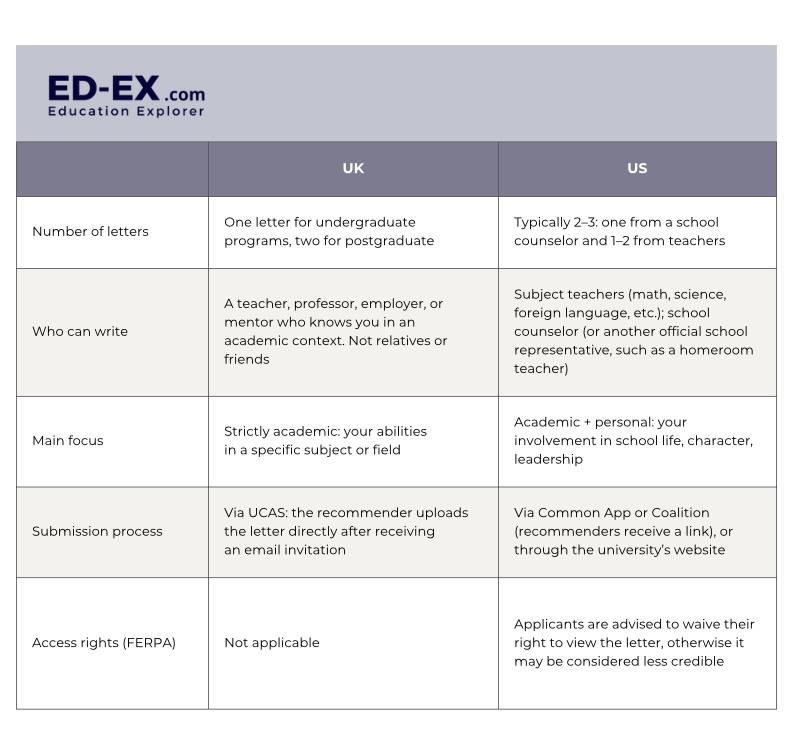
Note: FERPA (Family Educational Rights and Privacy Act) is a US federal law that protects the privacy of student education records. It gives parents (and students over 18) the right to access records, request corrections, and control the disclosure of personal information.
On the Common App platform, you’ll be asked whether you waive your right to view recommendation letters (“FERPA waiver”). It is recommended to waive this right (select “Yes — waive my right”). If you choose to retain access, admissions committees may place less trust in the letter.
What if the same recommender writes for both the UK and the US?
If the same teacher is writing recommendations for both countries, the letters should be different.
For the UK: focus on the academic side — your knowledge, subject-specific skills, and achievements should be front and center.
For the US: you can use the UK letter as a base, but add more about your personality, class participation, initiative, leadership, and other soft skills.
Common mistakes when preparing recommendation letters
Choosing a prestigious recommender who doesn’t know you well: the letter will be too generic and not very useful. It’s better to ask a teacher who can give specific examples.
Using clichéd phrases without examples: saying “an excellent student” means nothing. Admissions officers want to understand why you’re strong and what sets you apart.
Asking too late: recommenders are usually busy people. The later you ask, the lower the quality of the letter is likely to be.
Ignoring FERPA (for US applications): not waiving your rights can reduce the credibility of the letter.
Sending the same letter to US and UK universities: the expectations in each country are fundamentally different (see above).
Personal Statement for the US and the UK
A personal statement is an essay where you explain why you’re applying, why you’re a strong fit for the program and university, and what sets you apart from other applicants.
Requirements for personal statements in the US and the UK differ:
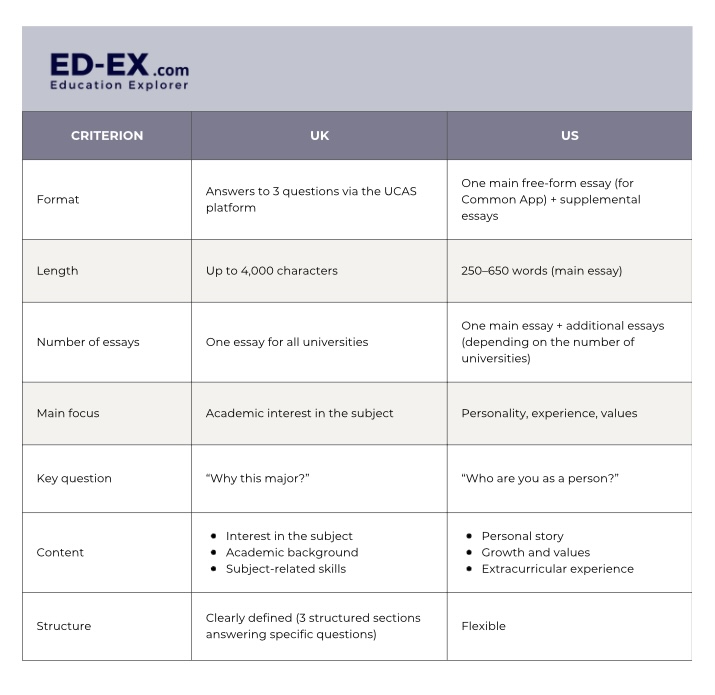
For a detailed guide on how to write a UCAS personal statement in 2026, read more here.
English Language Certificates
If your previous education was in English and you have official proof, you may be exempt from taking a language test. Otherwise, international students must confirm their English proficiency.
UK universities typically accept IELTS Academic, TOEFL iBT, Pearson PTE Academic, and Cambridge English (CAE, CPE). Score reports are uploaded as scanned copies through the UCAS platform. Keep in mind that English test requirements are set by each university — not UCAS — so it’s important to check them in advance.
US universities usually accept TOEFL iBT, IELTS Academic, and the Duolingo English Test. Many universities also require official score reports to be sent directly from the test provider.
Timeline: What to Do in Advance vs. Closer to the Deadline
To avoid planning mistakes, it’s best to break the process into stages and stick to a clear timeline. Ideally, add each task to your calendar with reminders so you don’t miss important deadlines.
The earlier you start, the better. This gives you enough time to choose the right universities and programs, prepare for exams, and gather all required documents.
1.5–2 years before applying:
Research universities and programs, review their requirements
Shortlist 5–10 universities
Find out if you need a Foundation Year (for example, if your school system is 11 years)
Assess your English level
Start preparing for IELTS / TOEFL / SAT
12 months before:
Take your English test (leave time for a retake if needed)
Register for SAT / ACT (if required)
6–9 months before:
Request transcripts or predicted/current grades from your school
Write the first draft of your personal statement
Choose recommenders and ask them to prepare letters
3–4 months before:
Register on UCAS or Common App
Ask recommenders to upload/send their letters
Do a final check of all documents
1–2 months before the deadline:
Submit your application and send official test scores to universities. Don’t leave it until the last day!
Most Common Mistakes Students Make
Uncertified translations: Self-translations or translations without certification are not accepted. Use only certified translation services.
Missing stamps and signatures: A document copy without an official school stamp is not considered valid.
Name inconsistencies: Carefully check that your name is spelled exactly the same in your passport, diploma, and translations. Even a small typo can lead to serious issues, including rejection.
Using the same recommendation letters for the US and the UK: As mentioned earlier, requirements differ significantly between the two countries. Keep this in mind when asking for letters.
Delays with recommendation letters: If your recommenders don’t submit letters on time, your application will be considered incomplete. Add their contact details to the system 2–3 weeks before the deadline and politely remind them.
AI-generated personal statements: UCAS and Common App check essays for AI use. A suspicious application may be disqualified.
Mentioning a university name in a UCAS essay: Your Personal Statement is sent to all 5 selected universities, so avoid naming a specific one. Refer to the course or subject instead.
Help with Document Preparation
ED-EX.com specialists help applicants prepare a complete set of documents for applying to international universities. The team will review each document, ensure translations are properly done, and help you avoid technical mistakes when uploading to UCAS or Common App.
Find out more and book a one-on-one consultation with an ED-EX.com expert.