



If you’re dreaming of studying in the UK, chances are you’ve already heard of the Russell Group — an association of the country’s most prestigious universities. In this article, we’ll break down what the Russell Group actually is, the advantages of studying at these elite institutions, and whether they’re always the best choice for every student.
Contents:
What is the Russell Group?
Benefits of Russell Group universities
Russell Group universities in the QS World University Rankings 2026
Why the Russell Group isn’t the only great option?
How to choose a university that fits your goals?
The best UK universities outside the Russell Group
Who is the Russell Group best suited for?
Frequently Asked Questions (FAQ)
What Is the Russell Group?
The Russell Group is an association of 24 leading public research universities in the UK. These institutions are considered the elite of British higher education and are often compared to the Ivy League in the United States.
The group was founded in 1994 and got its name from the first (then informal) meeting of university representatives at the Russell Hotel in London’s Russell Square.
All Russell Group universities have strong academic reputations and world-class research facilities. They also make a major contribution to the UK economy: together, the 24 universities generate around £87 billion for the country each year.
Universities in the Russell Group:
These universities receive more than two-thirds of all UK research grant funding. Around one in four undergraduate students in the UK studies at a Russell Group university.
Benefits of Russell Group Universities
For international students, being part of the Russell Group is often seen as a sign of academic excellence and strong career prospects — and in many ways, that reputation is well deserved.
Here are some of the biggest advantages of studying at a Russell Group university:
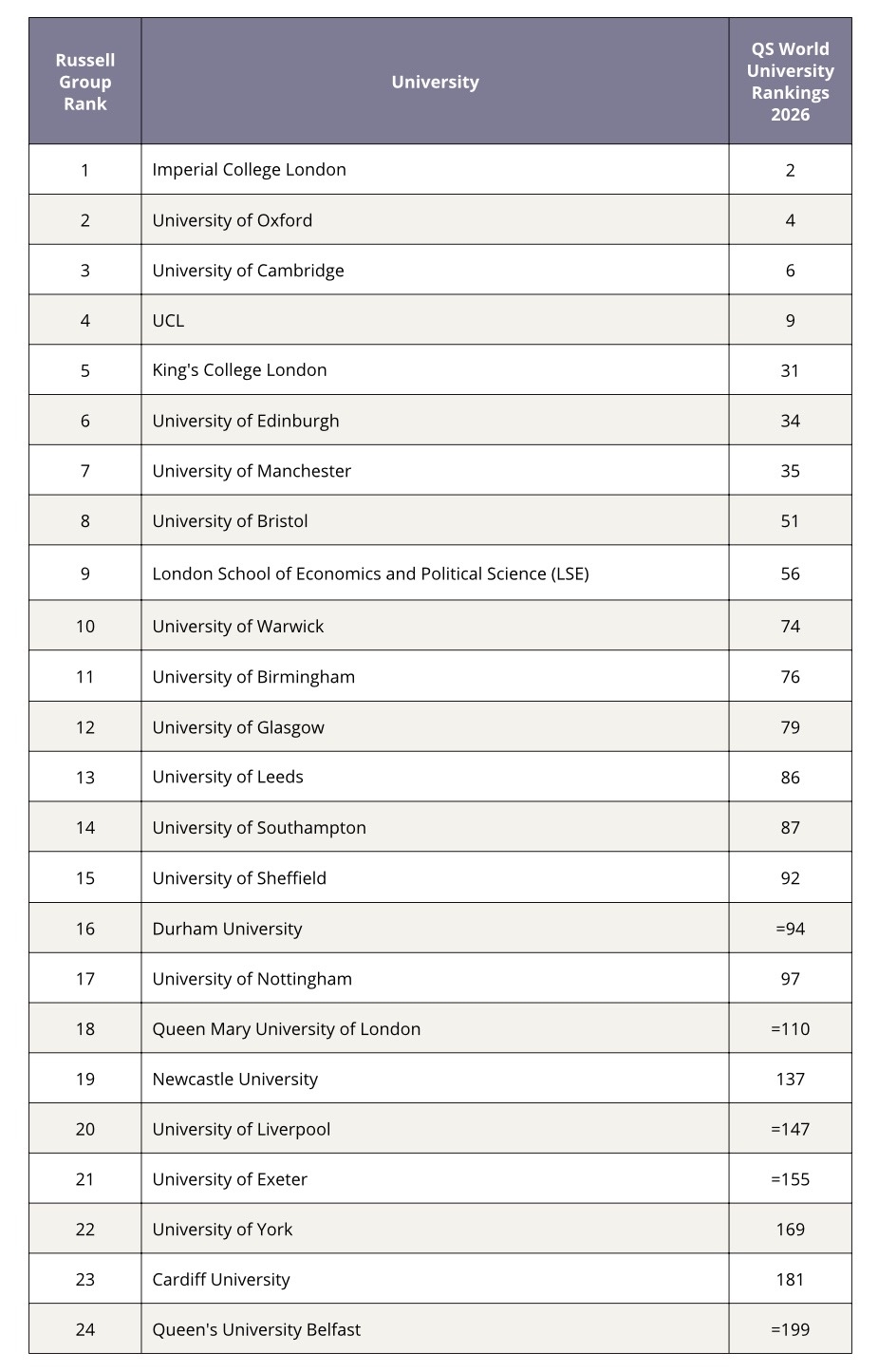
Global reputation and top rankings. Most UK universities that appear at the top of international rankings are members of the Russell Group. For example, Imperial College London ranks 2nd in the QS World University Rankings 2026, Oxford is 4th, and Cambridge is 6th.
Degrees recognized worldwide. Employers highly value graduates from Russell Group universities, especially in fields like finance, banking, consulting, law, and technology. Graduates build careers not only in the UK — the Russell Group brand is respected across the globe.
Higher starting salaries. Statistics show that Russell Group graduates earn around 10% more on average than graduates from other universities, while unemployment rates among them tend to be lower.
Strong research opportunities. Russell Group universities receive substantial government funding for research and participate in major international projects, including collaborations with companies like Meta in the field of AI. This creates excellent opportunities for students interested in research and innovation.
Access to cutting-edge technology. Students work in modern labs and research centers and often collaborate with major tech and pharmaceutical companies. As a result, they gain valuable hands-on experience while still at university.
Excellent graduate employability. According to Russell Group data, 80% of graduates secure graduate-level jobs within 15 months of finishing their studies. In addition, Russell Group graduates fill around 61% of all graduate-level positions in the UK.
A powerful international alumni network. Graduates of Russell Group universities hold leadership roles in global corporations, research institutions, government organizations, and tech startups. These connections can help students expand their professional network, gain mentorship, and build their careers more effectively.
A highly motivated academic environment. Admission to Russell Group universities is usually very competitive, meaning students study alongside ambitious and driven peers. This creates an inspiring environment for both academic and personal growth.
Russell Group Universities in the QS World University Rankings 2026
All Russell Group universities are ranked among the world’s top 200 universities in the QS rankings. See the table below for details:
Why the Russell Group Isn’t the Only Great Option?
Despite the prestige of the Russell Group, membership alone doesn’t automatically mean a university is the “best” fit for every student. The UK has many outstanding universities outside the Russell Group that perform extremely well in global rankings, show strong graduate employment outcomes, and have excellent reputations in specific subject areas.
Most employers don’t focus solely on a university’s brand name. They also look at a candidate’s practical skills, internship experience, and portfolio — all of which can absolutely be gained at other top universities outside the Russell Group.
Reason #1: Many non-Russell Group universities rank among the world’s best.
For example:
University of St Andrews ranks 113th globally in the QS World University Rankings 2026 — higher than some Russell Group universities.
University of Bath ranks 132nd in the QS rankings and is consistently placed in the UK top 10 across several national league tables.
Lancaster University ranks 157th globally in the QS World University Rankings 2026 and is also included in the UK top 10 according to the Complete University Guide 2026.
These universities may not belong to the Russell Group, but they are consistently recognized for excellent teaching quality, strong academic preparation, and high student satisfaction.
Reason #2: Some non-Russell Group universities are stronger in specific subjects.
For example:
University of Bath is especially well known for engineering, architecture, business, and sports sciences.
Loughborough University is considered one of the world’s leading universities for sports-related subjects.
University of the Arts London has an international reputation in design, fashion, and the arts.
University of Surrey is highly regarded for hospitality management and engineering programs.
In many industries, employers care less about the university’s overall brand and more about the reputation of a specific department or degree program.
Reason #3: Employers value skills — not just prestige.
The job market is gradually changing. More and more employers are paying attention to candidates’:
hands-on experience,
internships,
professional skills,
project involvement,
teamwork abilities,
adaptability and initiative.
This trend is especially noticeable in fields such as:
IT and computer science,
digital marketing,
design,
engineering,
media and creative industries.
As a result, graduates from strong non-Russell Group universities with solid portfolios and internship experience are often more competitive than graduates from more prestigious universities who lack practical training.
Reason #4: Universities outside the Russell Group also have excellent graduate employment rates.
For example:
University of Bath is considered one of the UK’s top universities for employer reputation. In the QS 2026 rankings, it placed in the global top 100 for this indicator.
Durham University ranks 64th worldwide for graduate employability in the QS rankings.
Coventry University demonstrates a very high employability rate: 95% of graduates either find work or continue their studies within six months of graduating.
So strong career prospects are by no means limited to Russell Group students.
Reason #5: The Russell Group brand alone doesn’t guarantee career success.
It’s important to understand that university prestige alone won’t protect graduates from challenges in the job market. Experience, practical skills, internships, networking, and adaptability are becoming increasingly important factors for long-term career success.
The best university is the one that fits your goals, priorities, and strengths. Next, let’s look at how to choose a university that truly matches your personal ambitions and opportunities.
How to Choose a University That Fits Your Goals
One of the most common mistakes applicants make is choosing a university based solely on prestige or ranking position. That approach can be risky: first, because admission to top universities is highly competitive, and second, because you may end up at a university that simply doesn’t match your interests, learning style, or career goals.
When choosing a university, it’s important to consider several factors:
The quality of your specific program. A university’s overall ranking is far from the only indicator of educational quality. What matters much more is how strong the university is in the subject you actually plan to study.
Career prospects and internship opportunities. If your goal is to secure a good job after graduation, research the university’s graduate employment rates, internship opportunities, career services, and connections with employers.
Tuition fees and living costs. Studying in the UK is a major investment, so it’s important to consider not only tuition fees but also everyday living expenses. For example, living in London is significantly more expensive than in many other parts of the UK.
Support for international students. For international students, adapting to a new country and education system can be challenging. Check whether the university offers visa support, orientation programs, mental health services, and other forms of student support.
If you’re unsure which university is right for you, working with an admissions counselor can be extremely helpful.
The Best UK Universities Outside the Russell Group
University of St Andrews — one of the UK’s most prestigious universities, particularly strong in humanities, international relations, and economics. It regularly ranks above many Russell Group universities in national league tables.
University of Bath — known for excellent programs in engineering, business, architecture, and computer science. It’s also considered one of the UK’s top universities for graduate employability and employer reputation.
Lancaster University — consistently ranks among the UK’s best universities for teaching quality and student satisfaction. It is especially well known for Lancaster University Management School.
Loughborough University — a global leader in sports-related subjects, with additional strengths in engineering, design, and business.
University of Surrey — a respected university with strong programs in engineering, hospitality management, media, and computer science. It is also known for excellent graduate employment outcomes.
Aston University — particularly valued for its practice-oriented approach to education, strong employer connections, and business and technology programs.
University of the Arts London — one of the world’s leading universities for art, fashion, design, and creative industries.
Heriot-Watt University — known for strong programs in engineering, business, artificial intelligence, and applied sciences, as well as its highly international outlook.
Who Is the Russell Group Best Suited For?
Students who value global degree recognition. Russell Group universities have strong international reputations. For students planning to build international careers or work for global companies, this can be a major advantage.
Students aiming for highly competitive industries. In some fields, university prestige still plays an important role — especially in investment banking, consulting, international law, finance, and certain areas of technology.
Students interested in research-focused education. The Russell Group includes the UK’s largest research universities. These institutions receive a significant share of the country’s research funding and offer extensive opportunities for academic and scientific work.
Students who want strong professional networks and career connections. Russell Group universities often have influential alumni communities and close ties with employers. In many cases, this helps students secure internships, gain recommendations, and enter the international job market more quickly.
Students prepared for a demanding academic environment. Admission to Russell Group universities is usually highly competitive, and the workload can be intense, requiring a high level of independence and self-discipline.
It’s important to remember that the Russell Group is not a one-size-fits-all solution. For some students, it may genuinely be the perfect choice. For others, a university outside the Russell Group — but with a stronger program in their chosen field, a more supportive environment, or better opportunities aligned with their personal goals — may turn out to be a much better fit.
Frequently Asked Questions (FAQ)
1. Which universities are part of the Russell Group?
The Russell Group includes 24 leading research universities in the UK, such as Oxford, Cambridge, Imperial College London, UCL, LSE, the University of Edinburgh, King’s College London, and the University of Manchester. These institutions are considered some of the most prestigious in the country and are actively involved in international research projects.
2. Should you only apply to Russell Group universities?
Not necessarily. Despite the high status of the Russell Group, the UK also has excellent universities outside this group — for example, the University of St Andrews, the University of Bath, and Lancaster University. In many cases, the quality of a specific program matters more than the university’s brand name.
3. How important is the Russell Group for employment?
Russell Group universities do have a strong reputation among employers, especially in fields like finance, consulting, law, and science. However, modern employers are increasingly focused not just on the university name, but also on practical skills, internships, and a candidate’s real-world experience.
4. Which UK universities are considered the best outside the Russell Group?
Some of the strongest UK universities outside the Russell Group typically include:
Many of these universities rank highly in global rankings and show strong graduate employment outcomes.
5. What is better — the Russell Group or a university with a strong subject-specific program?
For most students, the quality of the program in their chosen subject is more important. For example, one university may be stronger in engineering, while another excels in design or business. That’s why it’s important to look not only at overall rankings, but also at the reputation of the specific department.
6. Is it difficult to get into Russell Group universities?
Yes, admission to many Russell Group universities is quite competitive, especially Oxford, Cambridge, LSE, Imperial College London, and UCL. Successful applicants usually need strong academic results, a compelling personal statement, and proof of English language proficiency.
7. How should international students choose a UK university?
When choosing a university, it’s important to consider:
program quality,
career prospects,
tuition fees and living costs,
internship opportunities,
support for international students,
teaching style and campus environment.
The best university is not always the most famous one, but the one that best fits your goals and career plans.
If you need help choosing a university and preparing your application abroad, you can book a one-on-one consultation with an ED-EX.com expert for more details.