



To apply to universities abroad, international students need to prove their English proficiency. One of the most widely used exams is IELTS Academic. Score requirements vary depending on the country, university, and program — we’ll break it down in this article.
Contents:
What IELTS is and why it matters
IELTS requirements at universities in the USA
IELTS requirements at universities in the UK
Can you study without IELTS? Alternative tests
What factors affect the minimum score
What to do if your IELTS score is too low
What IELTS Is and Why It Matters
IELTS (International English Language Testing System) is one of the most popular international English exams that proves your language proficiency for study, work, and immigration purposes. IELTS results are accepted by thousands of universities worldwide, including institutions in the UK and the USA.
The exam evaluates four key skills:
Listening
Reading
Writing
Speaking
The final score is given on a scale from 0 to 9, where 6.0–7.5 is the most common range required for university admission.
There are two versions of the test: Academic and General Training. For university admission, you need IELTS Academic, as it assesses skills required in an academic environment — working with complex information, using academic vocabulary, and writing in a formal style.
IELTS General Training is usually intended for immigration or non-academic work and is not suitable for university admission.
IELTS Requirements at Universities in the USA
In the United States, the most commonly used English test is TOEFL. However, IELTS is also widely accepted — more than 3,400 universities use it as proof of English proficiency.
Typical requirements:
Bachelor’s degree: 6.0–6.5
Master’s degree: 6.5–7.5
Top universities: 7.0 and above
Universities may also require minimum scores in each section (for example, no lower than 6.0 in Writing and Speaking).
Examples of universities and requirements:
MIT — from 7.0 (for both undergraduate and graduate programs)
Harvard University — from 7.0 for undergraduate, from 7.5 for graduate programs
University of California, Berkeley — from 6.5 for undergraduate, from 7.0 for graduate programs
University of Florida — from 6.0–6.5 (for both undergraduate and graduate programs)
Important: The U.S. education system is flexible. Around 90–95% of universities accept alternative tests such as TOEFL or Duolingo. About half of universities may waive English test requirements if certain conditions are met — for example, if previous education was completed in English.
IELTS Requirements at Universities in the UK
IELTS is the most commonly used exam for admission to universities in the United Kingdom. For studying, you need an English level equivalent to B2, which corresponds to an IELTS score of 6.0.
Most universities accept scores in the range of 6.0 to 7.0, depending on the program, level of study, and university prestige:
Foundation courses: 5.0–6.0
Bachelor’s degree: 6.0–6.5
Master’s degree: 6.5–7.0
Top universities and competitive programs (Medicine, Law): 7.0–7.5
Universities also usually set minimum scores per section of the exam:
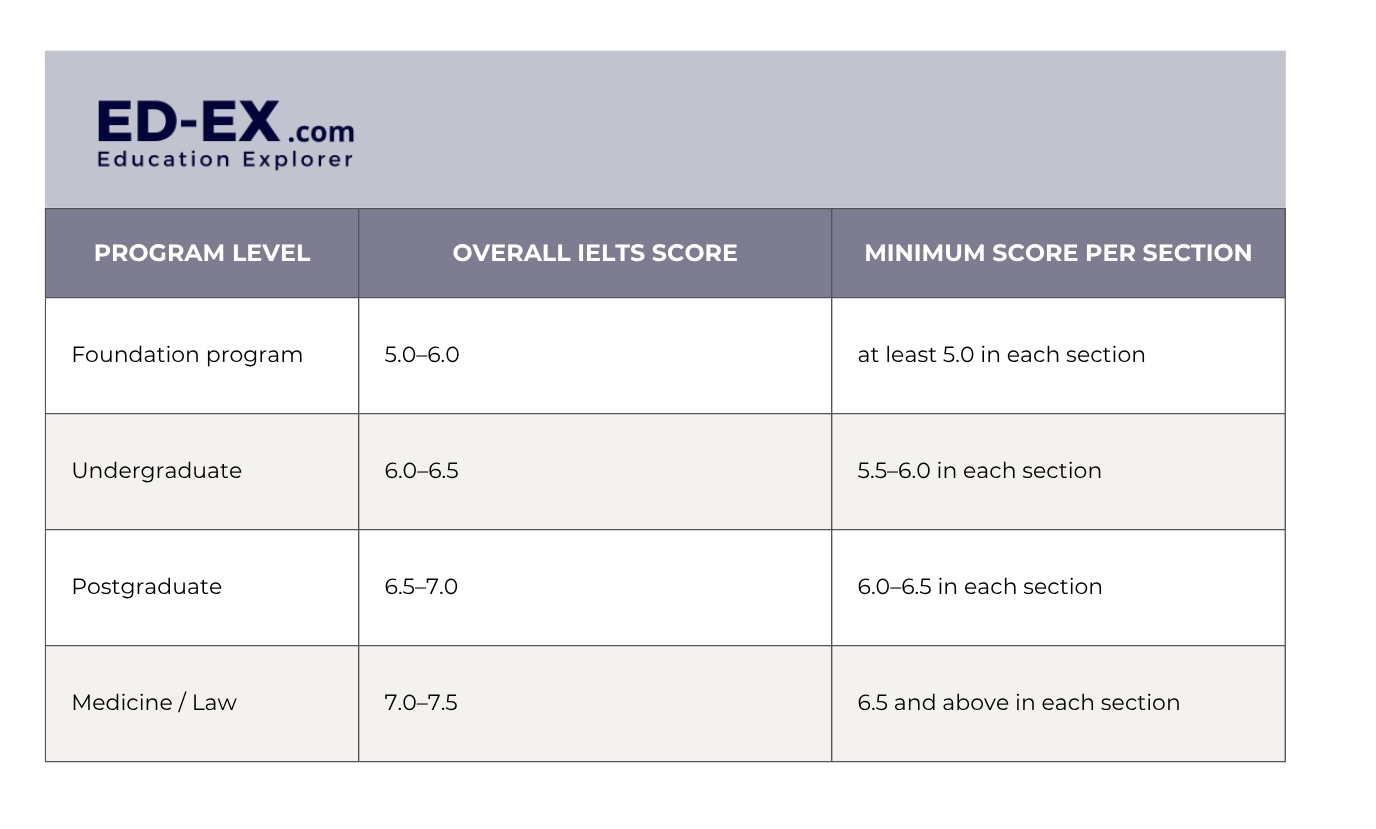
Important: The IELTS certificate is valid for 2 years, and most universities strictly follow this rule.
Examples of universities and requirements:
University of Cambridge — from 7.5 (for both undergraduate and graduate programs)
University of Oxford — from 7.0 for undergraduate, from 7.5 for graduate programs
Imperial College London — from 6.5 (for both undergraduate and graduate programs)
University of Manchester — from 6.0 (for both undergraduate and graduate programs)
University of Warwick — from 6.0 for undergraduate, from 6.5 for graduate programs
Can You Study Without IELTS? Alternative Tests
Yes — in many cases, IELTS is not the only option. The most common alternatives are:
TOEFL iBT
Duolingo English Test
PTE Academic
Cambridge English (CAE, CPE)
Internal university exams
For example, universities in the United Kingdom officially accept different types of tests, including Cambridge exams and TOEFL.
There are also situations where IELTS is not required:
if you studied in English (with a valid Medium of Instruction Certificate, MOI),
if you are from an English-speaking country,
if you take the university’s internal assessment.
In the USA, these options are more common than in the UK — as mentioned earlier, the American system is generally more flexible.
What Factors Affect the Minimum Score?
1. University prestige and ranking. More competitive universities usually set higher requirements. For example, Ivy League universities often require 7.5, and in some cases even 8.0.
2. Field of study. Programs that require a lot of writing, presentations, and discussions (such as social sciences, humanities, journalism, and law) usually require a higher level of English. Programs in natural sciences and engineering can sometimes be more flexible with individual section scores, but they rarely lower the overall minimum requirement.
3. Level of study. Master’s and PhD programs generally require a higher level of English. Positions such as teaching assistants or research roles may also have additional requirements for Speaking or Writing.
4. Intake (application semester). In some universities, requirements may vary slightly depending on the intake (fall or spring semester) and the level of competition among applicants.
What to Do If Your IELTS Score Is Too Low?
A low IELTS score is not the end of the road. Applicants who do not meet the direct entry requirements can consider the following options:
Foundation or pathway programs
Pre-sessional English courses
Conditional admission
Many universities in the USA and the UK accept students with IELTS scores of 5.0–5.5 into foundation programs. After completing them, students can move on to their main degree program without retaking the exam.
Another possible alternative is conditional admission. Read more about conditional and unconditional admission here.
Support with Studying Abroad
Even if your score is below the requirement, there are still alternative pathways: foundation programs, other exams, or conditional admission. Our experts can help you understand your options and build the right application strategy.
The ED-EX.com team helps students from all over the world:
assess real chances of admission,
choose suitable universities,
develop a strategy that allows admission even with a less-than-perfect IELTS score.
Don’t risk your future. Learn more and book a personal consultation today.